
2026 Future 5 Awardees

Each year, AOC showcases five young professionals as the year's Future 5, recognizing those who actively innovate and strive for excellence as they build their careers in in electromagnetic warfare, spectrum operation, and information operations.
Please join us in celebrating this year’s Future 5!

Barrett Batten
Northrop Grumman
Education
BS in Computer Science and AB in Cognitive Science, University of Georgia
MS in Computer Science, Georgia Institute of Technology (In Progress)
Career Goal
My ultimate career goal within the industry is to start to scale a defense technology company that strengthens the US industrial base, supports regional economies across the country, and delivers electromagnetic superiority to the United States and its allies.
Career Achievement
My biggest career achievement to date was receiving Northrop Grumman’s Rising Innovator award, which recognized me as the top early career performer for my contributions across electromagnetic warfare, data analytics, and defense information infrastructure modernization. This recognition was especially meaningful because it reflected impact across multiple mission areas. I supported work related to the AN/ALQ-161A Countermeasure System, contributing to a mission-critical EW program that protects one of the nation’s most important strategic aircraft. I also contributed to EW data analytics efforts, where software and automation can help improve how technical teams analyze, interpret, and act on complex mission data. In addition, I supported efforts to modernize information infrastructure for the US Air Force and the intelligence community, helping advance the secure cloud and digital foundations needed for future defense operations. What made this achievement significant was not only the award itself, but what it represented: my ability to contribute meaningfully as an early career engineer across legacy EW systems, emerging analytics workflows, and modern cloud-enabled defense infrastructure. These experiences reinforced my belief that the future of EW, EMSO, and IO will depend on professionals who can work across technical boundaries and connect software, data, infrastructure, and mission outcomes. Receiving the Rising Innovator award validated that I was already making measurable contributions to the national security mission early in my career. It also strengthened my commitment to continue growing as a technical leader in the community.
AOC Chapter


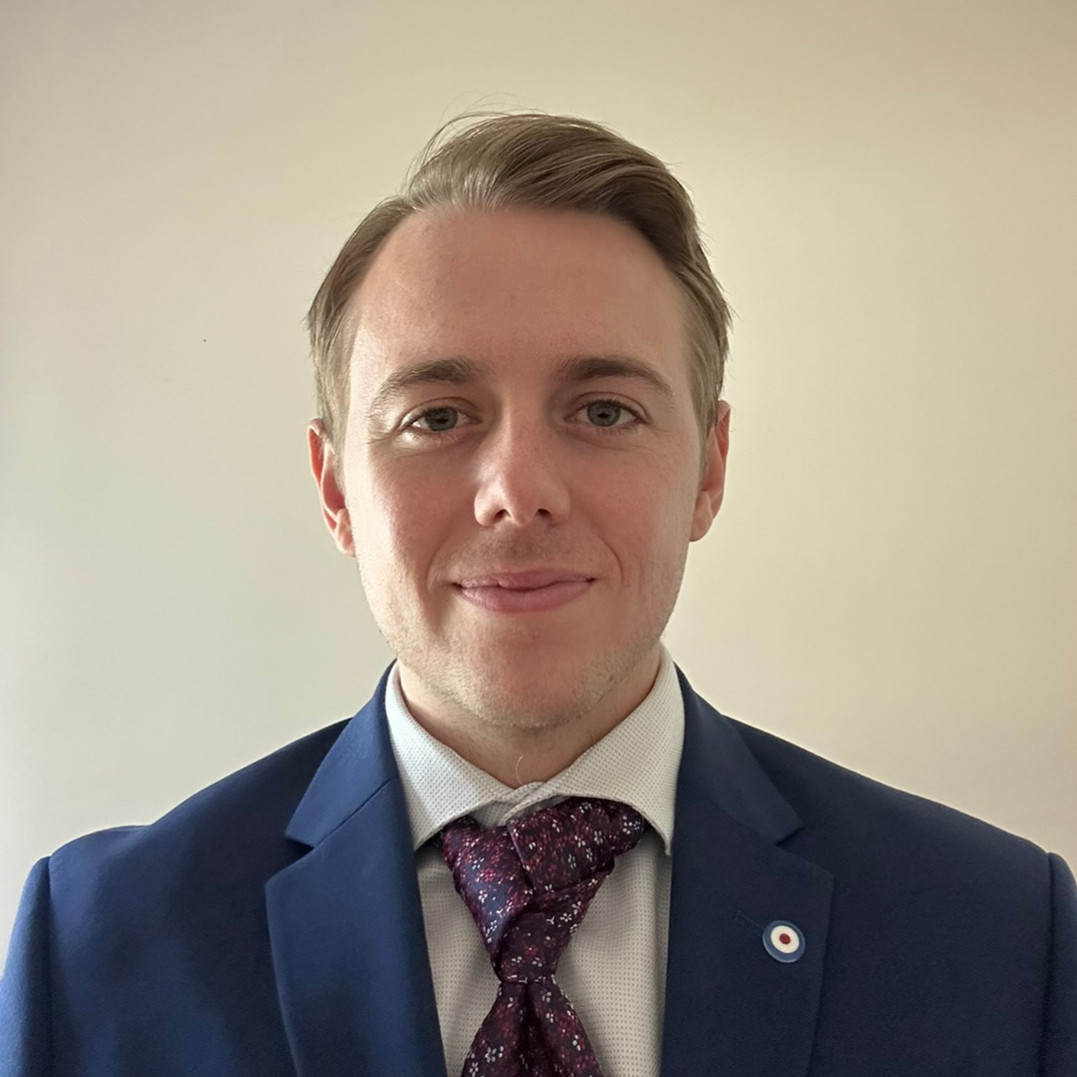

Griffin Murphy
Southwest Research Institute
Education
Master's in Electrical Engineering, Mercer University
Career Goal
My ultimate career goal is to be a leader in the development, implementation, and maintenance of standardizations throughout the EW industry to allow integration and proliferation of new technology at the speed the warfighter needs. It is evident that a major problem slowing down development and driving up cost in our industry is vendor-lock. As a firmware engineer in the industry, I want to do all I can to help fix this by driving standardization. As part of this effort, I joined the SOSA Consortium and quickly found myself in a leadership role as the head of the Hardware Acceleration Environment Subcommittee. Since then, I have greatly enjoyed introducing new members of the consortium and my subcommittee to my goal and mentoring them in their work. I also enjoy introducing junior and student engineers at SwRI to my work and teaching them how the standards are being used to benefit the industry. I hope that my continued work towards this goal will allow for more opportunities to help EW engineers collaborate and assist each other.
Career Achievement
My greatest career achievement has been the successful joint project with a third-party vendor that I led. Our goal was to prove that we could take SwRI firmware and package it in an encrypted black box to then be used on a third-party system. During this test, I utilized my experience in firmware development to generate an encrypted technique generator to be implemented on the third-party system. I then worked closely with vendor to assist in testing and integrating the encrypted firmware into their system. We ensured that everything worked in simulation before testing it on their hardware. Once everything was checked, the technique generator was integrated into the third-party system and used in a flight test. My technique generator added significant functionality to the system and enabled a successful flight test. It also proved that we could successfully integrate encrypted firmware capabilities into other systems. This marked a major milestone in enabling standardization in the EW industry, and it marked an important achievement in my career.
AOC Chapter


Brooke Sapolsky
Critical Frequency Design
Education
BS in Electrical Engineering, University of Florida
MS in Optics and Photonics, University of Central Florida
Career Goal
My ultimate career goal is to drive the meaningful integration of photonics into next generation EMS and EW systems by breaking down the artificial walls between RF and optical engineering. As photonics reshapes commercial communications, the defense community is at a pivotal moment: We need to adopt optical technologies and integrate them into existing architectures to unlock the next era of spectrum dominance. Too often, RF engineers refine traditional approaches while optical engineers push for full scale replacement. Real progress lies in merging the strengths of both. I want to spend my career uniting these communities and turning cutting edge research into practical, fieldable, and rapidly upgradable EW capabilities that directly support the warfighter. Leading two generations of RF photonic prototype builds showed me that meaningful innovation can’t come from siloed thinking. The real breakthroughs happened when my team pushed each other to creatively solve problems and understood constraints across disciplines deeply enough to know what could give, what couldn’t, and where to redesign to move the system forward. That collaboration is what transforms advanced photonics into operational capability. As I grow, I want to mentor engineers across disciplines and foster the kind of teamwork that accelerates real innovation. I see my long term path as becoming a chief engineer who bridges RF, photonics, and system architecture – someone who challenges assumptions, drives realistic integration strategies, and helps build an EMS/EW ecosystem where photonics is not a niche specialty, but a core, mission driven enabler for spectrum dominance.
Career Achievement
My biggest career achievement has been leading the design, integration, and test of a wideband dynamic interference cancellation system – Jammer Hammer – as the Lead Microwave Photonics Engineer at Critical Frequency Design. Over the past few years, I led a team of six engineers across multiple disciplines in taking this technology from an early benchtop prototype to a field ready capability demonstrated for multiple DOD and industry users. I made architectural decisions that balanced performance, prototype adaptability, and risk to ensure subsystem compatibility with customer receivers. In every evaluation, the system expanded receiver dynamic range by a factor of 1,000 in the presence of strong, in-band interference – directly addressing long standing operational problems for EW and spectrum-dependent teams. Watching experienced engineers’ eyes widen as they saw their persistent interference disappear in real time reminded me why I do this work. It wasn’t just a successful demo; it was the moment I realized something I built was solving a real, chronic EW challenge and improving systems far beyond our lab. Seeing that impact firsthand brought me genuine joy and reaffirmed how vital innovation is in this domain as it directly affects mission readiness. This effort strengthened my role as a technical leader, from guiding cross disciplinary contributors to now driving the next phase: reducing form factor, improving manufacturability, and preparing for upcoming EW exercises such as Silent Swarm and Grey Flag. I’m excited to continue pushing the boundaries of interference resilient systems and contributing to the next generation of EW capabilities.
AOC Chapter
Spacecoast Chapter
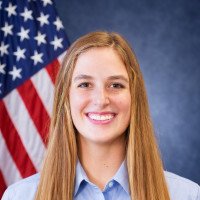
Victoria Evelina Teran
16th Electronic Warfare Squadron
Education
BS in Mathematics
MS in Interdisciplinary Data Science with a concentration in Applied Mathematics
Career Goal
My long term goals involve becoming chief engineer of my squadron and eventually moving into a Senior Executive Service position. This past year I worked on multiple cross flight, squadron, and organization missions working on complex problems and developing ways to improve processes across the Air Force. I found myself enjoying this type of work immensely. My curiosity was constantly fed by learning about new systems, threats, issues and working with many personalities. I love the people that I work with, have a passion for teaching/mentorship, and I am always looking to learn more things. A position like chief engineer sounds like it takes all of my best skills and puts them to use while still allowing me to grow as a person.
Career Achievement
My biggest career achievement was my contribution to Project Event Horizon. In January of 2025, the Air Force discontinued their support for VBA macros, which is the backbone for all the tools used in my squadron. I created and co-lead a team of six analysts as we migrate all VBA tools to a new data architecture in Python. This turned into a cross-functional collaboration with four other squadrons to optimize development across NIPR and SIPR. After months of meetings, collaboration and brainstorming, we created the 350th SWG first-ever NIPR to SIPR cross-domain solution. This reduced development time drastically and has set my team up for machine learning integration in the future. Project Event Horizon was a massive effort and forced me to grow in multiple areas. I went from just being a person in the room to a project leader briefing the Commander, Director of Operations and Chief Engineer. My skills as a developer and problem solver evolved rapidly because without these tools, our mission to keep the bomber alive was in jeopardy. We also pushed the boundaries of what the squadron thought was possible by advocating for machine learning and AI integration before it was broadly advertised by the government. We held training/resource sessions to spread awareness of what AI capabilities were out there, which turned into the creation of the DIVINCI Team. My efforts and contributions to this project were recognized when I won Category II Civilian of the Year at the Squadron, Group and Wing level.
AOC Chapter


Nicole Vitale
Lockheed Martin RMS
Education
Master's in Electrical and Computer Engineering
Career Goal
My ultimate career goal is to become a prominent chief engineer. This position would allow me to fulfill two supplementary goals: supporting the warfighter and our allies and being an influential role model. In recent years, we have seen the ever-changing and evolving landscape for the warfighter. As a chief engineer, I would be able to pursue and oversee a slew of opportunities that could enhance a product line-based portfolio focused on rapid development and deployment to aid our warfighters and our allies more efficiently. I plan to capitalize on NRE investments and similar opportunities to provide my teams with short-term, focused, attainable goals to provide improvements to the portfolio, benefitting all our stakeholders in the long-term. Our systems will be more adaptable to newer threats, increasing the likelihood of deployment to fielded systems, keeping pace with modern technologies, and matching the modern urgencies we face. I have been fortunate to have pivotal mentors throughout my career thus far, which is why my ancillary goal as a chief engineer is to return the favor. I have already been able to mentor a handful of young engineers, but I want to take it a step further and provide my teams’ engineers with opportunities that will challenge them and provide insurmountable growth. Additionally, I will humbly utilize all my past experiences to provide guidance and insight to those in similar positions in the future, providing my mentees with a “toolbox” to achieve their ultimate career goals.
Career Achievement
To date, my biggest career achievement has been leading an IRAD focused on developing an EW/SIGINT/C-C5ISRT open-system, hardware-agnostic architecture that can match the pace of today’s evolving technological landscape. I have been fortunate to help lead this team through an ongoing, exhaustive, and vigorous demonstration campaign, to expose the program and its potential to a multitude of customer bases and potential partnerships. Most recently, I led the team to a week-long demonstration at the Lockheed Martin Wayfinder facility in Honolulu, HI. The team had approximately eight weeks to enhance new signal processing capabilities, finalize the architectural foundation of our hardware abstraction layer, and produce a demonstrable, unclassified OV-1. I led a biweekly tag-up to track development against a roadmap, and I worked closely with the team to identify known unknowns and turn them into known knowns. The team coordinated such that we had remote support to account for time differences, and myself and the I&T lead held multiple dry-run sessions, including some with directors to quickly incorporate feedback on our demo presentation/flow. Ultimately, the team had a successful week where we presented to 50+ customers and completed 10+ demonstrations flawlessly, showcasing highlights of our system, including tactical reprogramming, rapid tech insertion, and scalability. I helped the team utilize this experience to further identify technical gaps, turning unknown knowns into known knowns. Additionally, and just as importantly, this effort has helped instill a sense of pride, where our project is notably gaining traction and receiving positive feedback, empowering the entire team.